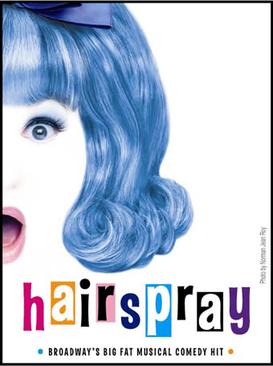
Hairspray(2002) Promotional Poster
John Street claims that the rules and conditions of a prize defines the type the winner the prize wants to be represented by (p.833). Does this explain the outcome of the 'Miss Teenage Hairspray' pageant as depicted in Hairspray(2007)?
Amber von Tussle (Brittany Snow) was usually the winner of the previous 'Miss Teenage Hairspray' pageants as she received a lot of 'help' from her mother, Velma von Tussle (Michelle Pfeffier). Velma, being the station's manager, controlled almost all aspects of the competition from the selection of candidates to the voting, and she reflects the power the prize organisers. Even though mass voting is a transparent way of empowers the masses to decide on the winner, the organisers usually have complete influence over the judging process. As depicted in the film, the small act of Velma manipulating the vote already shows how powerless the audience are should the organisers want a certain person to win.
The sponsorship is represented by Harriman F. Spritzer (Paul Dooley), whose decisions are in the interest of promoting and selling the 'Ultra Clutch' Hairspray, and to uphold the good image of the brand. Therefore, as long as the winner is able to bring publicity and commercial gain to the sponsor(p.828), it would not have mattered whether Amber of Inez (Taylor Parks) won. On the other hand, the sponsor could have threaten to pull out if the winner was not in favour of the sponsor.
The culture industry described by Street is most represented by the the TV station and The Corny Collins show, which aims to generate good publicity and to promote their TV channel. To play to the tastes of the major ethnic group at that time and the popular, ideal image of being slim and beautiful, none of the pageant's contestants were African-American or obese even though they had proven that they were better at dancing as compared to the contestants. This ensured that the winner would definitely be slim, beautiful and not African-American, a hidden criteria for evaluation. However, once it was understood that the public accepted racial integration, the TV station can now lift the hidden criteria and select winners without fear of public disagreement. Therefore like Street has mentioned, the expectations of the public reaction plays an important part in the decision of the winner.
Conveniently, the TV station doubles up as a media station, therefore its image and the amount of publicity is within the control of the TV station itself. By controlling what the audience sees, the TV station can choose to focus on certain contestants or portray them in good light, therefore influencing the outcome of the winner. Nevertheless, it was allowing Inez to dance for a few minutes and the removal of Velma's control over the results which led to Inez being crowned the winner of the 'Miss Teenage Hairspray' pageant.
Given a fair voting system and impartiality of the voters, perhaps it was expected that the winner is someone who is not 'manufactured' to fit the conditions the media(TV station) wishes portray, but rather a true winner whos talent is awarded on merit. Definitely not Amber von Tussle.

From Ms Coleen
ReplyDelete"You have written an excellent analysis of the delicate balance between trying to control the audience for ideological reasons (Velma) and satisfying their taste for economic reasons (the sponsor and the television station). You need to consider how this balance is constantly striven for in the film. You may also want to reconsider your claim that the audience can be trusted to bring an objectivity and fairness to the judging process. This is implied by the film, and so it is as such that you need to make your claim: The film suggests that the masses can be depended on to make the right choice in a fair and unprejudiced manner. This is quite an optimistic reading of the nature of audiences. How would Macdonald help understand this situation? "